
Choosing among China’s best Cemented Carbide Inserts suppliers takes more than comparing prices. Buyers need to examine carbide grades, coating options, dimensional consistency, and support for specific machining conditions. A turning insert used on stainless steel may need different wear resistance and edge strength from one cutting cast iron. Details matter.
As a practical editorial principle, tooling specialist Alex Chen says, “A reliable insert is the one that performs consistently in your actual cutting conditions.” This is a buyer-focused line for this introduction, not a verified quotation from a named industry source. Supplier claims still need checking against samples, inspection records, and clear technical data.
This guide will compare suppliers by manufacturing capability, product range, customization, quality control, and communication. Look for concrete evidence: documented grade specifications, stable edge geometry, and test results relevant to your workpiece and machine. A polished catalogue is useful. It is not proof. Even a strong supplier may not suit every application, so trial cuts and careful review remain worthwhile.
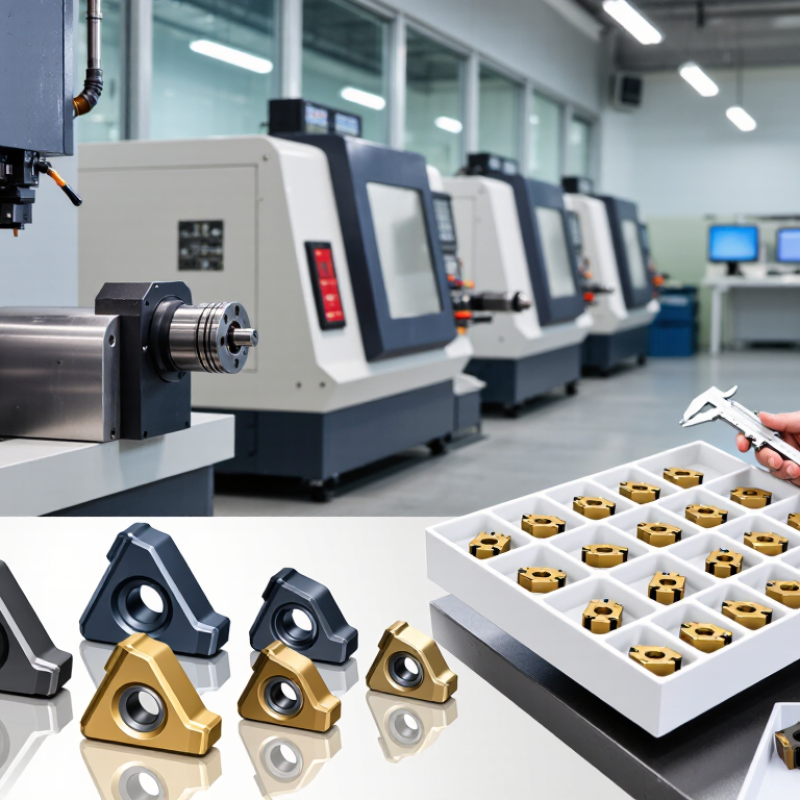
Cemented carbide inserts are replaceable cutting tips made from hard tungsten-carbide grains held together by a metallic binder, commonly cobalt. Their compact design lets operators replace a cutting edge without changing the entire tool holder. On a lathe, a triangular insert might face a steel shaft, while a rounded nose can better withstand interrupted cuts. Inserts are also used in milling, drilling, and boring, where heat and abrasion wear ordinary tool materials quickly. Details matter. Grade, geometry, coating, and chipbreaker shape all influence cutting performance.
Selection should start with the workpiece and cutting conditions, not a catalog claim. Stainless steel may require a tougher grade and controlled feed, while cast iron often benefits from a wear-resistant edge. Cutting speed, depth, coolant, machine rigidity, and chip shape should be considered together. Long, hot chips can indicate poor chip control; edge chipping may point to vibration or an overly brittle grade. Hardness alone is a poor shortcut. Even a suitable insert can disappoint when the setup is loose or the workpiece varies. Keep notes on tool life and surface finish, then adjust one variable at a time. The process is not always tidy, but careful observation helps.

Chinese suppliers commonly make inserts for turning, milling, drilling, threading, and grooving. Turning inserts are available in shapes such as triangular, diamond, and round, each suited to different cutting paths and access needs. Milling inserts often have multiple cutting edges, helping shops use each insert efficiently. Drill inserts may be designed for replaceable tips or specific hole-making systems. Threading and grooving types use narrow, carefully shaped edges to form threads or cut precise channels.
Tips: Match the insert shape, grade, and coating to the workpiece and operation. Check the toolholder code and cutting data before ordering. A small mismatch can cause chatter or poor finish.
Supplier catalogs may group products by application, geometry, or material, so compare the actual specifications rather than relying on category names alone. Carbide grades differ in toughness and wear resistance; there is no universally best option. Ask for sample inserts or technical guidance when testing an unfamiliar material. Then inspect the finished surface and edge wear under consistent cutting conditions. Results can vary with machine rigidity, coolant, and setup, and even a suitable insert may need adjustment.
| Insert Type | Common Shapes or Designations | Typical Operations | Common Workpiece Materials | Typical Material or Coating Options | Selection Considerations |
|---|---|---|---|---|---|
| Turning inserts | ISO shapes include C (80° diamond), D (55° diamond), V (35° diamond), S (square), T (triangle), and R (round) | External and internal turning, facing, and profiling | Steels, stainless steels, cast irons, non-ferrous metals, and heat-resistant alloys | Cemented carbide grades with CVD or PVD coatings; uncoated grades are also used for some applications | Match the shape and nose radius to the required profile, workpiece access, surface finish, and cutting load. |
| Milling inserts | Common forms include square, round, triangular, and octagonal inserts | Face milling, shoulder milling, slot milling, and other indexable milling operations | Steels, cast irons, stainless steels, and non-ferrous materials | Coated or uncoated carbide grades selected for the material and milling conditions | Consider cutter compatibility, insert geometry, cutting edge strength, and whether the operation is roughing or finishing. |
| Drilling inserts | Indexable drill inserts, often designed as central and peripheral inserts for compatible drill bodies | Holemaking with indexable drills | Steels, cast irons, and other materials covered by the selected drill and grade | Application-specific carbide grades, commonly with a wear-resistant coating | Use inserts designed for the drill body; check diameter range, insert position, chip evacuation, and workpiece material. |
| Threading inserts | Full-profile or partial-profile forms for external or internal threads | Single-point thread turning | Steels, stainless steels, cast irons, and non-ferrous materials | Carbide grades and edge preparations selected for the thread material and cutting method | Confirm thread standard, pitch, profile, handedness, and whether the insert is for internal or external threading. |
| Grooving and parting inserts | Narrow, straight-edged inserts in widths matched to the toolholder and operation | External or internal grooving, face grooving, and parting-off | Steels, stainless steels, cast irons, and non-ferrous materials | Carbide grades with suitable toughness and wear resistance; coating depends on the workpiece and cutting conditions | Check groove width and depth, toolholder compatibility, chip control, and stability, especially for parting operations. |
| Copying and profiling inserts | Commonly round or diamond-shaped inserts, including small-angle profiles | Contour turning, form turning, and machining complex profiles | Steels, stainless steels, cast irons, and heat-resistant alloys | Coated or uncoated grades chosen for the material, edge geometry, and required finish | Round edges can provide strength, while sharper-angle shapes can improve access to narrow profiles. |
| Finishing inserts | Sharp-edged geometries, often with small nose radii or wiper-style features | Finishing turning and milling where surface quality is important | Material-dependent; common choices cover steels, stainless steels, cast irons, and non-ferrous metals | Fine-grain carbide grades; uncoated or PVD-coated options may be selected depending on the application | Balance edge sharpness, nose radius, feed rate, rigidity, and the required surface finish. |
China’s cemented carbide insert suppliers typically begin with tungsten carbide powder and a measured cobalt binder. The powders are milled, dried, and pressed into compact shapes under controlled pressure. Small differences in particle size or moisture can affect density. Details matter. The pressed blanks are sintered in a furnace, where heat bonds the material into a hard, wear-resistant structure. After sintering, suppliers grind the insert to its specified dimensions and form its cutting edges. Some grades receive a coating, while others remain uncoated for applications where a sharp edge or clean finish is preferred.
Testing should check more than appearance. Inspectors measure insert thickness, corner radius, and other critical dimensions with calibrated gauges. Hardness tests and microscopic checks can reveal variation or internal defects, though neither test alone predicts performance in every machine. Cutting trials provide useful evidence: technicians may record tool wear, surface finish, and cutting stability on a defined workpiece. Results should be linked to production batches, so a problem can be traced back to its process conditions. Still, a laboratory trial cannot reproduce every shop floor. Suppliers should explain the test setup clearly, including material, speed, and feed rate, rather than relying on broad claims.
The chart shows a typical production sequence, from powder preparation through final inspection. The numbers indicate process order only; they are not production times, performance measurements, or quality scores. Actual routes can vary by insert design and supplier.
Choosing a cemented carbide insert supplier in China takes more than comparing catalog prices. Start with the insert’s intended work: workpiece material, cutting speed, feed rate, and machine rigidity. A grade suited to cast iron may wear quickly on stainless steel. Ask suppliers to explain their grade recommendations and provide usable application data, not just broad performance claims.
Check dimensional tolerances, edge preparation, coating details, and batch inspection records. These details affect fit and tool life on the shop floor. Request sample inserts and test them under repeatable cutting conditions. Record tool life, surface finish, and chip control. A supplier’s response to test results also matters; clear, specific answers are more useful than confident promises. Small differences between batches can still disrupt production.
Tips: Share a drawing and real cutting conditions before requesting a quote. Confirm packaging, lead time, and replacement procedures in writing. Ask how material grades and production batches are traced. One point is easy to miss: the lowest price may not reflect setup time or scrap. Recheck the numbers.
Comparing suppliers means looking beyond the quoted price. Ask for the insert grade, coating details, dimensional tolerances, and recommended cutting conditions. These affect tool life and finished-part quality. Check whether the supplier can provide inspection records for a recent batch, not just a general certificate. Response time matters, too. A clear answer about a chipped edge is more useful than a polished brochure.
Tips: Send the same drawing and workpiece details to each supplier. Include material hardness, machine type, and cutting speed. Compare sample inserts under consistent conditions, then record tool life, surface finish, and edge wear. Keep the test modest; one trial rarely tells the whole story.
Also review minimum order quantities, lead times, packaging, and replacement procedures. Ask how the supplier handles grade changes between batches. If possible, inspect a sample under magnification for edge consistency and coating defects. A low unit price can become costly when inserts arrive late or vary in performance. Still, a spreadsheet cannot capture every shop-floor issue. Confirm results with your own operators before committing to a large order, and allow time for a second test if results look inconsistent.
© 2023 JEM Electronics, Inc. – United States Cable Assembly. All rights reserved.