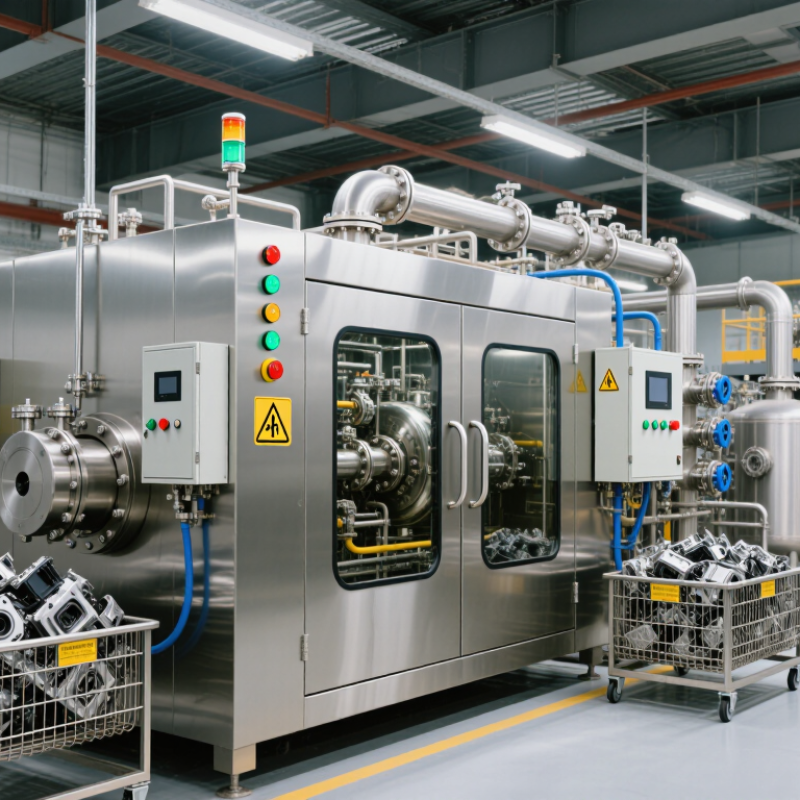
Precision cleaning is now a practical requirement in automotive, aerospace, electronics, and metalworking production. A vacuum hydrocarbon cleaning machine removes oils and machining residues inside an enclosed chamber. Vacuum stages help limit solvent exposure and support repeatable drying. Results still depend on part geometry, soil type, solvent choice, and process settings.
The International Energy Agency’s Energy Efficiency 2023 report estimates that industry accounts for about 37% of global energy use. That figure does not prove that one cleaning system saves energy. It does explain why buyers increasingly examine cycle time, heating demand, solvent recovery, and utility consumption together. Details matter. So does verification. Ask manufacturers for test data based on representative parts, not only polished demonstrations.
This guide considers China Vacuum Hydrocarbon Cleaning Machine Manufacturers through practical criteria: chamber capacity, filtration and distillation design, automation, safety interlocks, service access, and documented quality controls. Reliable suppliers should explain their process limits and provide clear commissioning and maintenance support. Buyers should also confirm that equipment specifications match their site requirements and applicable safety standards. A brochure is not enough. One overlooked detail can change the result. This comparison is not a universal ranking; factory audits, sample trials, and transparent references remain important before purchase.
A vacuum hydrocarbon cleaning machine removes oil, grease, and machining residue from metal parts using a hydrocarbon-based solvent inside a sealed chamber. Vacuum does not simply “pull dirt away.” Instead, it helps remove air from small cavities and supports controlled solvent recovery and drying. The exact cycle depends on the machine and the part.
A typical cycle begins when a basket of components enters the chamber. The system may spray or immerse the parts in filtered solvent, allowing it to reach drilled passages and narrow gaps. A drain stage carries loosened soil away. Some machines then use a cleaner solvent rinse to reduce remaining residue. It can be surprisingly quiet.
After cleaning, vacuum drying helps evaporate solvent left on surfaces and in accessible cavities. The vapor is condensed and returned to the recovery system, rather than intentionally released into the work area. Sensors and interlocks monitor operating conditions, while filtration helps limit particle carryover. They matter.
In real workshops, results still depend on details: soil type, part geometry, solvent condition, and cycle settings. A blind hole may retain liquid longer than a flat plate. Operators should verify cleanliness with a suitable inspection method, especially when parts have tight tolerances. The process is controlled, but not infallible. Proper maintenance and training are essential for consistent cleaning and safe operation.
Industrial plants use vacuum hydrocarbon cleaning to remove oil, grease, and polishing residues from complex parts. Typical automotive loads include bearings, valve bodies, transmission components, and electric-motor housings. The IEA’s Global EV Outlook 2024 reports nearly 14 million electric-car sales in 2023, around 18% of global car sales. That growth increases demand for clean, repeatable components before assembly.
Cleanliness is not cosmetic. For gear teeth and blind bores, fixture orientation and drainage still affect results.
Inside a vacuum chamber, hydrocarbon solvent reaches narrow passages, while vacuum-assisted drying helps limit retained liquid. Operators can record bath condition, cycle time, and particle-test results for each batch. These records make process checks more useful than visual inspection alone.
The method suits oil-based soils, but it is not a universal answer for salts or water-soluble residues. Test real production parts first. That step is often skipped. It matters because soil type, part geometry, and drying requirements can change the result.
The IEA’s sales figure is not a cleaning-market statistic; it indicates growth in one demanding application area.
China’s vacuum hydrocarbon cleaning machine manufacturing landscape reflects a broad industrial base. China’s Ministry of Industry and Information Technology reported manufacturing value added of 33.1 trillion yuan in 2023. That scale supports local production of vacuum vessels, pumps, filtration systems, and automated controls. Yet factory capacity alone does not prove cleaning performance. A catalog number alone proves little.
Buyers and engineers should examine chamber leak integrity, solvent recovery, drying consistency, and basket loading. A greasy component hidden in a dense load may not clean like a test coupon. Small details matter. The International Energy Agency’s Energy Efficiency 2023 report estimates that industry accounts for about 37% of global energy use. This figure is not specific to cleaning equipment, but it makes energy use a relevant comparison point. Ask suppliers for measured cycle data, utility consumption, and repeatability under realistic loads. Comparisons can still be messy: part geometry, soil type, and maintenance change results. That uncertainty deserves attention, not a footnote.
Normal boiling points of selected hydrocarbon solvents at 1 atm (°C). Boiling point is one factor in solvent selection; commercial cleaning fluids may be blends, and actual performance depends on the process and equipment.
China Best Vacuum Hydrocarbon Cleaning Machine Manufacturers
How to Evaluate Chinese Manufacturers and Their Equipment
Choosing a Chinese manufacturer takes more than comparing quoted prices. Ask how the machine handles your actual parts, soil type, and production volume. A useful technical review covers chamber size, vacuum performance, wash and rinse stages, drying time, and solvent recovery. Request a process diagram and written cycle parameters, not just a brochure. Details matter.
Inspect the chamber door seal, piping, filters, and control interface. Ask how temperature and pressure are monitored, and what alarms appear if readings drift. Request test results using representative parts, with clear acceptance criteria for cleanliness and drying. A factory visit can reveal assembly quality, but it cannot replace a documented trial. Ask for maintenance intervals, spare-parts guidance, operator training, and service response expectations. Check references from customers with similar components, while remembering that their process may differ from yours. I would not rely on a single impressive demonstration; the sample load may be unusually easy.
Tips: Ask for evidence. Run a trial. Look closely. Record cycle time, residual contamination, and visible marks before approving specifications. A small gap in the test plan can become a production headache later.
When evaluating vacuum hydrocarbon cleaning machine manufacturers, look beyond chamber size and advertised cycle time. Ask for material-compatibility data, operating limits, and test results using parts similar to yours. A stainless-steel basket, narrow passages, or delicate seals can change cleaning performance. Ask for evidence. Review the proposed solvent system, recovery method, and expected consumption before comparing prices.
Safety depends on the complete installation, not just the machine enclosure. Check how the system monitors pressure, temperature, solvent levels, and ventilation. Request clear procedures for loading parts, responding to alarms, and maintaining seals and filters. Small details matter. Watch a full cycle if possible, and note vapor controls, operator access, and noise. Even a detailed checklist can miss a practical issue; operators should review the workflow before purchase.
Compliance requirements vary by location, facility, and solvent. Ask suppliers for equipment documentation, electrical specifications, maintenance records, and relevant conformity evidence, then have qualified local professionals assess the installation. Confirm how emissions, waste handling, fire protection, and worker training will be addressed. Do not rely on a broad claim such as “compliant worldwide.” Keep records of commissioning and routine inspections. A careful sourcing process takes time, and some questions may remain open until the machine is tested with real production parts.
| Evaluation Area | What to Check | Evidence to Request | Safety and Compliance Considerations | Buyer Verification |
|---|---|---|---|---|
| Cleaning process and application fit | Confirm the machine’s process stages, such as solvent immersion, spray, vacuum cleaning, rinsing, and drying, against the part geometry and contamination type. | Process description, equipment layout, cycle sequence, and trial-cleaning report using representative parts and soils. | Cleaning results depend on the solvent, temperature, pressure, part design, and contamination; a machine specification alone does not establish cleaning performance. | Agree on measurable acceptance criteria, such as residual contamination, particle limits, or visual cleanliness, before ordering. |
| Solvent compatibility | Check compatibility of the proposed hydrocarbon solvent with seals, hoses, pumps, filters, coatings, and the materials being cleaned. | Solvent technical data sheet (TDS), safety data sheet (SDS), compatibility information, and a list of wetted machine materials. | Flash point, vapor pressure, exposure limits, and fire classification vary by solvent formulation. Review the SDS for the exact solvent to be used. | Confirm the solvent grade, operating temperature range, and any restrictions with the solvent supplier and the machine supplier. |
| Vacuum and drying performance | Review the operating vacuum range, leak detection approach, drying cycle, and provisions for recovering solvent vapor. | Vacuum-system specifications, cycle data from a representative load, and details of vapor condensation or recovery equipment. | Vacuum operation can assist drying and reduce vapor release, but it does not by itself eliminate flammable-atmosphere or exposure hazards. | Request test results under the expected load conditions and verify that the proposed cycle meets production and dryness requirements. |
| Machine capacity and throughput | Compare usable chamber dimensions, basket or fixture capacity, load weight, and total cycle time with actual production needs. | Dimensioned drawings, rated load limits, recommended loading patterns, and cycle-time assumptions. | Overloading or obstructing circulation can affect cleaning, drying, and safe operation. | Validate throughput using the planned parts, fixtures, batch size, and operating schedule rather than relying on an unloaded cycle time. |
| Flammable-liquid and fire-risk controls | Check how the design manages solvent inventory, ignition sources, abnormal temperatures, leaks, and emergency shutdowns. | Hazard analysis, electrical documentation, alarm and interlock list, emergency-stop details, and fire-protection design information. | Applicable requirements depend on the site and jurisdiction. In the United States, OSHA 29 CFR 1910.106 and relevant NFPA standards may apply; confirm applicability with qualified safety professionals and local authorities. | Have the installation design and site risk assessment reviewed before purchase and commissioning. |
| Electrical and hazardous-area suitability | Determine whether any equipment is intended for a classified hazardous area and whether its electrical design matches the site classification. | Electrical schematics, component ratings, hazardous-area certificates where applicable, and the equipment’s intended area classification. | ATEX and IECEx-related requirements may be relevant in some markets; U.S. installations may use different hazardous-location rules. Certification scope and jurisdiction must be checked. | Ask the site electrical engineer or authority having jurisdiction to confirm the required classification and documentation. |
| Emissions and workplace exposure | Review enclosure integrity, exhaust or vapor recovery provisions, access-door interlocks, and maintenance procedures that may expose workers to solvent. | Emission-control description, ventilation requirements, exposure-control guidance, and maintenance instructions. | Vacuum cleaning does not replace workplace ventilation or exposure controls. Applicable occupational exposure requirements vary by solvent and jurisdiction. | Assess the installation location and worker exposure controls with an industrial hygienist or competent safety professional where needed. |
| Solvent recovery and waste handling | Check filtration, distillation or recovery options, water separation where relevant, and the handling of spent solvent and residues. | Recovery-system flow diagram, maintenance intervals, consumables list, and guidance for managing process residues. | Recovered solvent quality and waste classification depend on the process and local environmental rules; waste must be characterized and managed accordingly. | Estimate solvent consumption and waste streams using the expected operating hours, soil load, and recovery method. |
| Quality control and process monitoring | Review monitoring of temperature, pressure, vacuum, cycle time, and other process variables relevant to repeatable cleaning. | Instrument list, calibration requirements, alarm limits, data-logging options, and sample cycle records. | Monitoring and recordkeeping needs may be set by the buyer’s quality system, customer requirements, or regulated application. | Define which parameters must be recorded, retained, and traceable to each production batch. |
| Machine guarding and operator access | Inspect access doors, interlocks, pinch-point protection, loading aids, maintenance access, and lockout provisions. | Risk assessment, operator manual, maintenance manual, and descriptions of safety-related controls. | Safety requirements depend on the machine configuration and applicable local machinery and workplace rules. | Include operator and maintenance personnel in a design review before finalizing the machine layout. |
| Supplier qualification and factory acceptance | Evaluate the supplier’s experience with comparable applications, engineering support, documentation quality, and production controls. | References for comparable installations, quality-system documentation, inspection records, and a factory acceptance test (FAT) plan. | Certificates and declarations should identify their scope, issuing body where applicable, equipment model, and applicable market; do not assume a certificate covers the full installation. | Specify FAT criteria, test instruments, acceptance tolerances, documentation, and corrective-action procedures in the purchase contract. |
| Installation, service, and lifecycle cost | Account for utilities, ventilation, foundations, solvent supply, commissioning, training, spare parts, and planned maintenance. | Utility schedule, installation requirements, recommended spare-parts list, service response terms, and training plan. | Site preparation and operation may require permits, ventilation reviews, fire-protection measures, or other local approvals. | Compare total cost of ownership, including solvent, energy, filters, waste disposal, maintenance, and production downtime. |

Note: Regulatory requirements depend on the destination market, solvent, installation, and intended use. Verify current requirements with the relevant authorities and qualified safety, environmental, and engineering professionals before procurement and commissioning.
© 2023 JEM Electronics, Inc. – United States Cable Assembly. All rights reserved.