
Choosing an EV charger in Malaysia is not just a matter of picking the highest power rating. Your car’s charging limit, home electrical supply, parking arrangement, and daily driving distance all affect what makes sense. A terrace house with a dedicated parking bay may suit a different setup from a condominium with shared facilities. Small details matter.
This guide to Feyree Ev Charger Malaysia explains the practical checks to make before choosing a unit in 2026. Compare connector compatibility and AC charging capacity with your vehicle’s specifications. Check cable length against the distance from the parking spot to the power source. In Malaysia’s hot, humid, and rainy conditions, ask about the charger’s weather protection and suitable installation location. Do not assume every model fits every home.
A reliable decision also depends on installation quality, warranty terms, and access to support. Ask a qualified installer to assess the available supply and explain any upgrades before you commit. For apartment residents, confirm that the proposed installation works with the building’s parking and electrical arrangements. Details can vary by property.
Useful features are only useful when you will use them. An app, scheduling option, or adjustable charging current may help, but each adds questions about setup and support. Compare the actual specifications, not just promotional claims. And leave room for doubt. A charger that looks ideal online may feel awkward beside your car or require a longer cable than expected. Check those practical points before buying.
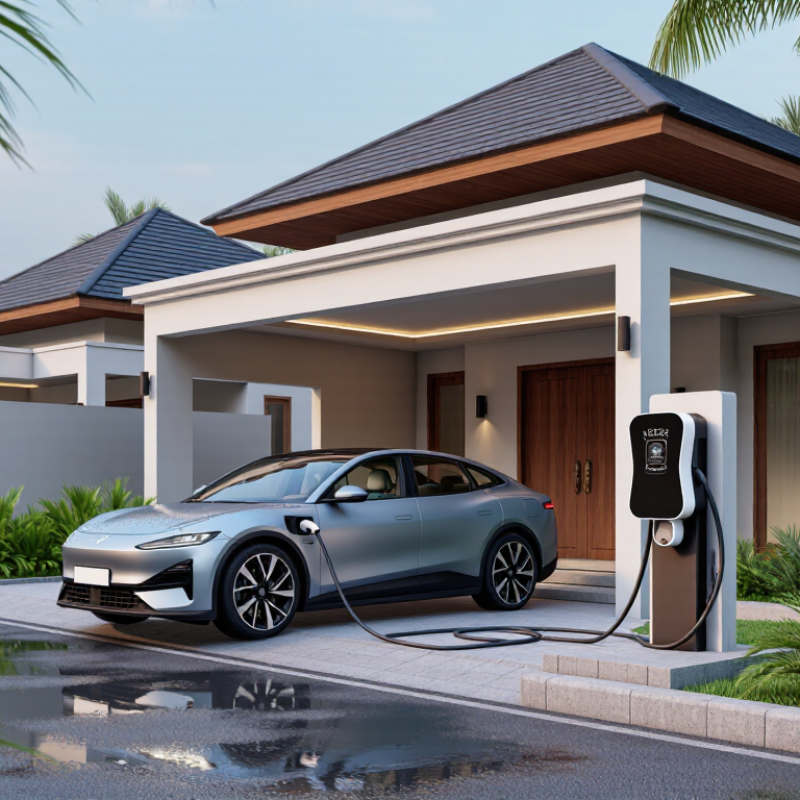
Choosing between 7.4, 11, and 22 kW AC charging starts with your car, not the charger’s headline rating. Check the vehicle manual for its maximum AC charging rate. A car limited to 7.4 kW will not charge faster from a 22 kW unit. That matters.
A 7.4 kW charger commonly uses a single-phase connection, while 11 and 22 kW units generally need three-phase power. Your home’s supply, wiring, and available electrical capacity must support the chosen option. In Malaysia, ask a qualified electrician to assess the installation and verify the vehicle connector and charging settings. Do not assume every house can support the highest output. It may need upgrades.
For a typical overnight routine, 7.4 kW may be enough if the car is parked for several hours. An 11 kW charger can suit vehicles with a compatible onboard charger and homes with three-phase supply. A 22 kW unit makes sense only when both the vehicle and site can use that power; otherwise, its extra capacity may sit unused. Compare your usual battery top-up, parking window, and future vehicle plans. I would still avoid choosing by peak speed alone; real charging can vary with temperature, battery level, and electrical load. A little spare capacity is useful, but not at any cost.

Compare common AC charger outputs. The vehicle’s onboard charger and the available electrical supply determine the charging power you can actually use.
Approximate ideal time to add 50 kWh is 6.8 hours at 7.4 kW, 4.5 hours at 11 kW, or 2.3 hours at 22 kW. Real charging can take longer due to charging losses and limits imposed by the vehicle or electrical supply. Choose an output your EV can accept and your installation can support.
Before choosing a home EV charger in Malaysia, check whether your property has 230 V single-phase or 400 V three-phase supply. These are the nominal low-voltage values specified in IEC 60038. Check the meter. A single-phase circuit may support around 7.4 kW at 230 V and 32 A, while three-phase can deliver about 11 kW at 400 V and 16 A per phase. These are examples, not guarantees. Your main breaker, existing household loads, cable size, and charger settings all affect the safe available capacity. A neat specification sheet can mislead.
Ask a qualified electrical contractor to confirm the supply type and assess the installation before selecting charger output. Three-phase service does not automatically mean faster charging; the vehicle’s onboard charger must also accept three-phase AC. If the home has single-phase supply, a compatible charger can still provide useful overnight charging. The International Energy Agency’s Global EV Outlook 2024 reported more than four million public charging points worldwide in 2023, highlighting the expanding charging network, but home charging still depends on the property’s actual electrical capacity.
Small detail, big difference. Allow for future household loads, too; that part is easy to overlook.
When choosing an EV charger in Malaysia for 2026, check the vehicle’s inlet before comparing charging speeds. A Type 2 plug is specified under IEC 62196-2, but a matching shape alone does not confirm full compatibility. The charger and car must also communicate correctly during charging. IEC 61851-1 sets requirements for conductive charging systems, including the control signals used in AC charging.
Look for support for the relevant AC charging mode, then verify the vehicle manual’s maximum AC power, phase configuration, and current limits. Small details matter. A three-phase charger may still charge a single-phase vehicle, but the car may not use the charger’s full rated output.
The International Energy Agency’s Global EV Outlook 2024 reports that public charging points worldwide grew by about 40% in 2023, reaching nearly 4 million. That expansion makes connector and system checks more useful, not less: public access does not guarantee every station suits every car.
Before installation, compare the charger specification sheet with the vehicle documentation, and ask a qualified installer to confirm the supply and protective equipment. Check cable length against the parking layout, too. A cable that barely reaches can become a daily annoyance. I would not rely on a seller’s “universal” claim without seeing the IEC references and the exact charging limits in writing.
A 7.4 kW charger usually draws 32 A from a 230 V single-phase supply. A 22 kW unit typically needs 32 A across three phases at about 400 V. The numbers look close on paper, but the wiring requirements are not. Check this first.
Ask a qualified electrician to inspect your home’s supply, main breaker, cable route, and existing loads. An air conditioner, oven, and charger may run together in the evening. That matters. The available capacity can be lower than the supply rating suggests, especially in an older home or a shared parking area. A load-management feature may help, but it cannot replace a proper site assessment.
Your car’s onboard AC charger also sets a limit. If it accepts only 11 kW AC, a 22 kW wall unit will not make it charge at 22 kW. Likewise, a three-phase charger may need a suitable three-phase connection; a 32 A label alone does not guarantee compatibility. Actual charging can also slow as the battery fills. One detail is easy to overlook: cable length and parking position affect daily convenience. Compare the installation quote and your vehicle’s AC limit before choosing. I would not assume the larger rating is automatically better.
When comparing EV chargers for Malaysian use, assess smart controls and weather resistance together. A charger beside an open car porch may face wind-driven rain, humid air, and afternoon heat. Check its IP rating: IP54 offers limited dust protection and resistance to splashing, while IP65 is dust-tight and resists water jets. Neither rating means the unit can be submerged. Placement still matters.
Smart features should solve a real household problem. Scheduled charging can use off-peak electricity plans where available, while dynamic load management can reduce the risk of overloading a home circuit. Check whether the app needs reliable Wi-Fi at the parking space; concrete walls can weaken the signal. Useful safety protections include overcurrent, overtemperature, surge, and residual-current protection. Ask a qualified electrician to verify the supply, earthing, and protective devices before installation. A high IP rating cannot compensate for poor wiring. I would also check how firmware updates work and what happens if the internet drops. That part is easy to overlook. A charger can look rugged on a product page, yet its cable connector may still need shelter from standing water and direct sun.
| Comparison Dimension | What to Check | Useful Facts and Ratings | Consideration for Malaysian Use |
|---|---|---|---|
| Charging power and supply | Match the charger's phase and maximum current to the vehicle, the property's electrical supply and the installation design. | Typical AC examples include approximately 7.4 kW at 32 A on single-phase 230 V, and approximately 11 kW at 16 A or 22 kW at 32 A on three-phase 400 V. Actual output depends on the vehicle and available supply. | Have a qualified electrical professional assess the supply capacity and circuit before choosing a power rating. A higher-rated charger does not make a vehicle charge faster than its onboard AC charger allows. |
| App and connectivity | Check whether the charger supports Wi-Fi, Bluetooth or another connection method, and whether its core functions still work when internet access is unavailable. | Common app functions include starting or stopping a session, viewing charging status and reviewing energy use. Features vary by model and software. | Check the connection quality at the proposed parking location. Confirm whether app access, remote control or cloud services require an ongoing subscription. |
| Scheduling and energy management | Look for scheduled charging, adjustable current limits and dynamic load management if the property has other large electrical loads. | Load management can adjust charging current in response to measured site demand, when the charger and required metering equipment support that function. | Scheduling may help users choose preferred charging times, but electricity tariffs and availability depend on the user's supplier and tariff plan. |
| Access control | Compare app authentication, RFID access cards, user permissions and the ability to restrict charging. | RFID or account-based controls can help limit use to authorised users. Availability and user-management options differ across products. | Useful for shared parking or driveways where access needs to be controlled. Check that the chosen method is practical for every regular user. |
| Enclosure IP rating | Check the complete IP code on the product documentation and confirm that it applies to the installed enclosure and configuration. | Under IEC 60529, the first digit describes protection against solid objects and dust; the second describes protection against water. IP54 is dust-protected and protected against water splashes. IP65 is dust-tight and protected against water jets. | For a partly exposed location, consider the expected rain, wind-driven water, dust and installation position. An IP rating alone does not guarantee protection against every weather condition or incorrect installation. |
| Residual-current protection | Check the specified residual-current protection and whether DC leakage detection is built in or provided by the installation. | EV charging equipment needs appropriate protection against residual current. Depending on the equipment design, this may include Type B protection or Type A protection together with 6 mA DC residual-current detection. Follow the manufacturer's instructions and applicable installation requirements. | Ask the installer to verify the protective-device arrangement for the specific charger and circuit. Do not assume that every charger includes the same protection. |
| Electrical and temperature protections | Review documented protections such as overcurrent, overvoltage, undervoltage, earth-fault monitoring and temperature monitoring. | Protection functions vary between products. Check the product documentation and the applicable EV supply equipment requirements, including IEC 61851-1 where relevant. | Use a dedicated circuit designed for the charger's rated current. The installation should be assessed for the site conditions and completed in accordance with applicable Malaysian requirements. |
| Cable and connector | Confirm connector compatibility with the vehicle, cable reach, cable management and whether the cable is tethered or socketed. | AC connector type and charging capability must match the vehicle and charger. Cable length and connector options are product-specific. | Measure the parking position before purchase. Keep the cable route clear of walkways, vehicle tyres and locations where it could be damaged. |
| Installation and support | Check the installation scope, commissioning, warranty terms, service availability and access to replacement parts. | Installation requirements depend on the site's wiring, protective devices, earthing arrangement and supply capacity. | Use a qualified professional familiar with EV charger installations and applicable local requirements. Confirm who is responsible for inspection, testing and commissioning. |
| Quick selection guide | Prioritise features according to the parking location and how the charger will be used. | Outdoor parking: assess enclosure rating and exposure. Shared parking: consider access control. Limited electrical capacity: consider adjustable current and compatible load management. | Compare the full installation and operating requirements, not just the charger’s headline power or IP rating. |
| Important: Ratings and features are selection criteria, not a substitute for a site assessment. Verify the exact product documentation, vehicle compatibility and applicable Malaysian electrical requirements before installation. | |||
© 2023 JEM Electronics, Inc. – United States Cable Assembly. All rights reserved.