
2026 How to Choose a Tungsten Alloy Vibration Absorber
Choosing a Tungsten Alloy Vibration Absorber starts with the vibration problem, not the material’s impressive density. A motor, pump, or spindle may transmit unwanted motion through its mount, frame, or connected equipment. The right absorber depends on operating frequency, moving mass, available space, temperature, and how the assembly is supported. Small details count.
Tungsten heavy alloys are often selected when compact mass is useful. Commercial grades commonly offer densities around 17–18.5 g/cm³, though exact values depend on composition and supplier specifications. That can help designers add mass where space is tight. It does not guarantee vibration reduction. The USGS Mineral Commodity Summaries 2025 estimates global tungsten mine production at 81,000 metric tons in 2024, a useful reminder to consider material sourcing and lead times alongside performance. Check the actual grade data sheet; alloy names alone are not enough.
Standards help frame the measurements. ISO 20816 provides guidance for evaluating machine vibration, while ISO 2041 defines vibration and shock terminology. Neither standard selects an absorber for a specific installation. Engineers still need measured operating conditions and, where practical, testing on the assembled system. Not by calculation alone. A bracket that looks rigid on a drawing may flex under real loads, and a changed operating speed can shift the result. That uncertainty deserves attention. This guide explains how to compare alloy, geometry, mounting, and test data before choosing a Tungsten Alloy Vibration Absorber.
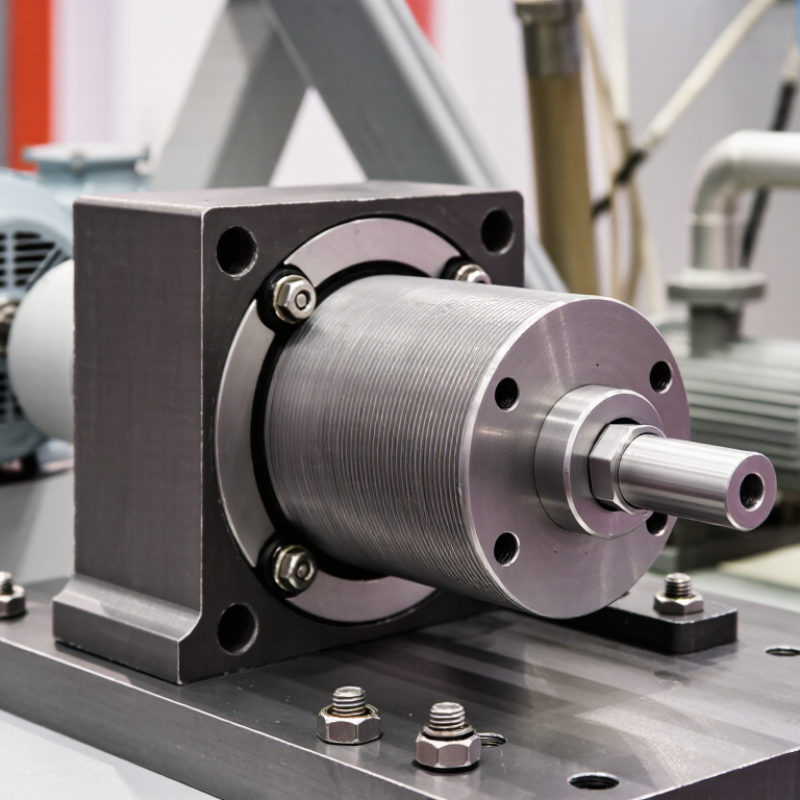
How Tungsten Alloy Vibration Absorbers Reduce Mechanical Vibrations
Mechanical vibration can begin with a small, repeated movement. A pump housing shivers; a motor bracket hums at one narrow frequency. A tungsten alloy vibration absorber packs substantial mass into limited space. Attached to the vibrating part, its moving mass is designed to respond near the troublesome frequency. As the structure moves, the absorber mass moves out of phase, reducing motion at the attachment point. Not magic. Just controlled motion.
The alloy supplies compact mass, while springs, flexures, and damping elements govern how energy is redirected and dissipated. That distinction matters: tungsten alone does not cancel vibration. An absorber tuned too far from the machine’s operating speed may do little, or amplify motion elsewhere. Select one by checking the vibration spectrum, available mounting area, temperature, and allowable added load. Then test it under real operating conditions with repeatable acceleration readings before and after installation. Sensor placement and machine load can affect results, so even a promising comparison deserves a second look.
2026 How to Choose a Tungsten Alloy Vibration Absorber - How Tungsten Alloy Vibration Absorbers Reduce Mechanical Vibrations
Use this engineering guide to screen material and design options. Reference figures are typical ranges or calculated examples, not guaranteed product specifications.
| Selection Dimension | Typical Value or Relationship | How It Affects Vibration Control | Practical Selection Check |
|---|---|---|---|
| Tungsten heavy-alloy density | Approximately 17.0–18.5 g/cm³ for many tungsten heavy alloys | High density provides substantial mass in a compact volume. Added mass can reduce vibration response or help tune a mass-based absorber. | Compare the required absorber mass with available space, mounting capacity, and allowable equipment weight. |
| Illustrative mass by absorber volume | 10 cm³: about 170–185 g 25 cm³: about 425–463 g 50 cm³: about 850–925 g | Calculated by multiplying volume by the density range above. Actual mass depends on the alloy grade, geometry, and any holes or inserts. | Use the supplier’s certified density and the final machined dimensions for a precise mass estimate. |
| Elastic modulus | Often approximately 300–400 GPa for tungsten heavy alloys; grade and processing affect the value | A stiff absorber body can maintain its shape, but stiffness alone does not guarantee effective vibration damping. | Check stress, deflection, attachment stiffness, and fatigue requirements for the operating load case. |
| Absorber tuning frequency | For a simplified mass-spring absorber: fn = (1/2π)√(k/m), where k is support stiffness and m is absorber mass | Increasing mass lowers the tuned natural frequency if support stiffness stays constant. A tuned absorber is most effective near its design frequency. | Measure the target vibration frequency and determine the effective stiffness of the complete mount-and-absorber assembly. |
| Energy dissipation | Depends on the complete system, including damping elements, joints, and interface materials | Tungsten alloy mainly contributes compact mass and stiffness; it should not be assumed to provide high damping by itself. | If resonance reduction is required, evaluate a viscoelastic layer, frictional interface, or other suitable damping mechanism. |
| Operating frequency and excitation | Determine from measured or specified vibration spectra; rotating machinery may produce running-speed and harmonic components | A mass absorber tuned away from the dominant excitation may provide limited benefit or amplify response at another frequency. | Collect frequency, amplitude, duty-cycle, and transient data before finalizing the absorber design. |
| Attachment and load path | Design-specific; bolts, clamps, bonded interfaces, and mounting surfaces create different stiffness and damping | Loose or flexible attachments can shift the tuning frequency, introduce impact, or reduce vibration transfer to the absorber. | Check fastener preload, contact pressure, surface flatness, joint fatigue, and retention under shock and vibration. |
| Environment and compatibility | Assess temperature, corrosion exposure, fluids, and contact with dissimilar materials for the actual installation | Environmental conditions can affect the alloy, fasteners, coatings, and especially any polymer damping layer. | Verify material compatibility and the temperature range of every component in the assembly. |
| Validation method | Modal or frequency-response testing before and after installation | Testing confirms whether the absorber shifts or reduces the target response and reveals unwanted resonances. | Compare measurements at the same operating conditions and inspect the full frequency range, not only one peak. |


© 2023 JEM Electronics, Inc. – United States Cable Assembly. All rights reserved.