
How to Choose the Longest Range Walkie Talkie
Choosing a Longest Range Walkie Talkie starts with a simple question: where will you use it? A clear, open field is very different from a wooded trail, a warehouse, or a neighborhood filled with buildings. Hills, walls, trees, and radio interference can all shorten communication distance. The range printed on a box usually reflects favorable test conditions, not every real-world situation. That number can feel reassuring. It is not a promise.
Look beyond the headline mileage. Check the radio’s frequency band, antenna design, power options, battery life, and independent test results when available. Consider whether you need to reach a hiking partner across open ground or coordinate a team around several corners. Those needs call for different equipment. A practical range test in a similar environment can reveal more than a dramatic product claim. Keep the radio upright, use a clear path when possible, and carry a charged spare battery on longer outings. Small details matter.
There is no single model that is best for everyone. I would be cautious about treating maximum range as the only measure of quality; dependable audio and comfortable controls matter too. Even careful comparisons have limits, because terrain and weather change. Review manufacturer specifications, confirm the device suits your intended use, and check current local requirements for radio equipment. A realistic choice may not have the biggest number. It should help you stay in contact where you actually go.
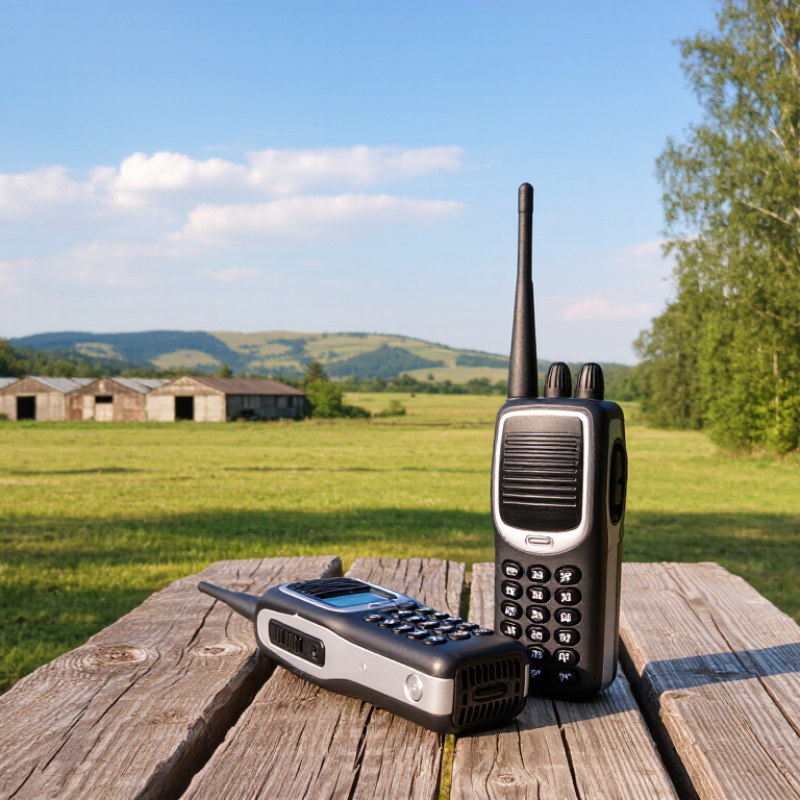
Understand How Walkie-Talkie Range Is Measured
Walkie-talkie range is not one fixed number. It describes how far two radios can communicate under particular conditions. A quoted maximum usually comes from open, unobstructed ground, with clear paths between the radios. That is not the same as a city street or a wooded trail.
Distance alone can mislead. Buildings, hills, trees, and even a radio held low behind a body can weaken a signal. Higher positions often help because fewer obstacles block the path. Antenna design and radio settings also matter, but real performance depends on the whole setup. Small details count.
For a practical comparison, test radios on the same route, at the same height, and with similar battery levels. Walk away from the other person in measured steps, checking whether speech remains clear at each point. Note where words become broken or disappear. Then repeat the test outdoors and around buildings. Results may vary; wind does not usually block radio waves, but it can make speech harder to hear. I once expected a clear signal around a corner. It failed sooner than expected. That is why a field test is more useful than treating a maximum-range figure as a promise.
How to Choose the Longest Range Walkie Talkie - Understand How Walkie-Talkie Range Is Measured
Walkie-talkie range is the distance at which two radios can exchange clear, usable messages—not simply the farthest distance at which a signal can be detected. The estimates below are illustrative for handheld radios and vary with radio specifications, antenna performance, local regulations, and conditions.
| Test environment | Typical usable range | What affects the signal | How to interpret the result |
|---|---|---|---|
| Dense urban area | About 0.5–2 km (0.3–1.2 mi) | Buildings, indoor use, vehicles, and other radio signals can block or weaken transmissions. | Expect shorter range between streets or inside buildings than in an open area. |
| Suburban area | About 1–4 km (0.6–2.5 mi) | Houses, trees, terrain, and the height of each radio influence coverage. | A clear path between users usually performs better than a route through buildings. |
| Open, flat terrain | About 3–8 km (1.9–5 mi) | Few obstructions help, but ground curvature, antenna height, and local interference still matter. | Useful for comparing radios only when both are tested in the same conditions. |
| Elevated locations with a clear line of sight | About 8–20 km (5–12 mi), sometimes more | Elevation and unobstructed paths can extend coverage; hills or ridges between radios can sharply reduce it. | Long distances are more plausible when both radios are elevated and have a clear path. |
| Indoor use or through multiple walls | Often a few hundred metres or less | Concrete, metal, reinforced structures, and basements can attenuate radio signals substantially. | Test in the actual building; outdoor range figures are not a reliable indoor guide. |
What to check when comparing range
- Look for test results that state the terrain, distance, radio positions, and whether speech remained intelligible.
- Compare radios using the same channel or frequency, settings, antenna orientation, and test route where permitted.
- Check the radio service and local rules: permitted frequencies, transmit power, antenna use, and licensing requirements differ by country and service.
- Treat maximum advertised distances as ideal-condition claims, not guaranteed everyday coverage.
- For dependable coverage over long distances or around terrain, consider whether a properly authorized repeater system is more suitable than relying on handheld-to-handheld range.
Measurement note: The ranges in this table are broad practical estimates, not guaranteed specifications. Actual results can be shorter or longer depending on equipment, terrain, obstructions, interference, and how “usable communication” is defined.

© 2023 JEM Electronics, Inc. – United States Cable Assembly. All rights reserved.