
Choosing an Air Compressor manufacturer is not just a matter of comparing brand names. A machine may run quietly in a workshop yet struggle with the steady demand of a production line. Buyers need to consider airflow, operating pressure, duty cycle, energy use, and access to maintenance. Small differences matter. An undersized unit can cause pressure drops; an oversized one may waste power.
This guide introduces ten manufacturers with a significant presence in the global market. It considers established names such as Atlas Copco, Ingersoll Rand, Kaeser, Sullair, ELGi, and other recognized producers. The list is an overview, not a universal ranking. Product ranges and regional support can change, and a strong reputation does not guarantee the right fit for every site.
For a fair comparison, look beyond the brochure. Check published performance data, warranty terms, service coverage, and the availability of filters, lubricants, and replacement parts. Ask how a compressor handles real operating conditions, including heat, dust, and fluctuating demand. Those details often shape lifetime cost more than the purchase price. And the cheapest option? Not always the economical one.
No short list can capture every local specialist or application. That limitation deserves attention. Use these manufacturer profiles as a starting point, then compare specifications against your own requirements. A careful match can support reliable air supply, reduce avoidable downtime, and make operating costs easier to understand.
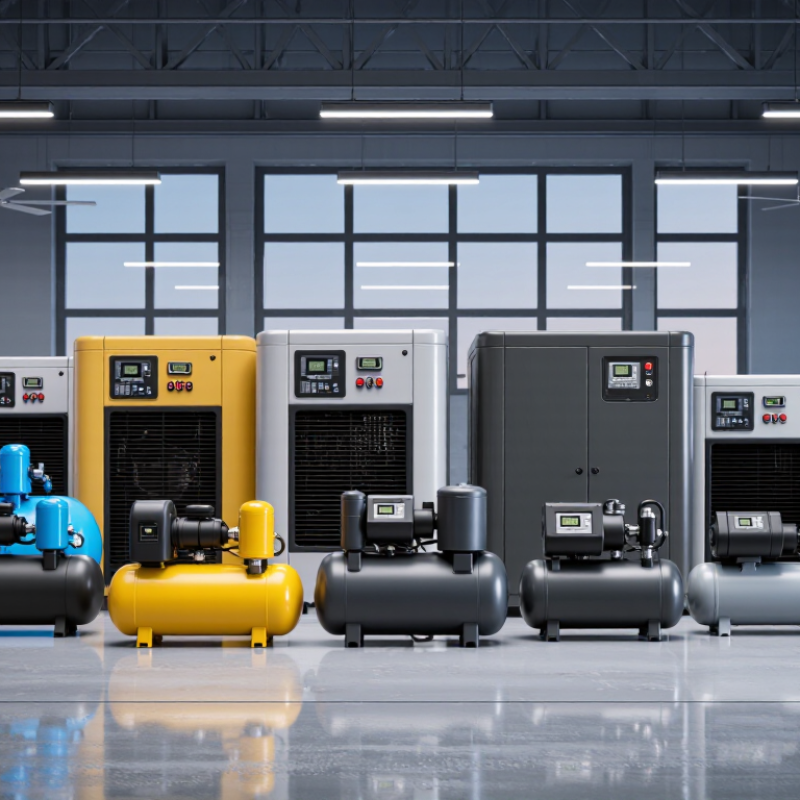
Air compressors supply energy for tools, controls, and production equipment, but each type suits a different duty cycle.
Reciprocating compressors deliver compressed air in bursts, making them useful in repair shops, small workshops, and backup systems. Their piston movement is easy to understand, though noise and heat can become drawbacks during frequent use.
Rotary screw compressors provide steady airflow for factories running pneumatic tools, packaging lines, or assembly equipment across long shifts.
Centrifugal compressors suit facilities with high, continuous air demand, such as large process plants. They need careful system design and may be less practical for smaller sites.
Oil-free models can support applications with strict air-quality requirements, including some food and pharmaceutical processes. However, “oil-free” does not remove the need to manage moisture, particles, and downstream filtration.
Match the compressor to required pressure, flow, operating hours, and air quality; peak demand alone can mislead.
Tips: Check the actual duty cycle before comparing machines. Log pressure and flow during a typical shift, then review leaks and receiver capacity. A slightly oversized unit may seem safer, but it can waste energy when demand stays low. Recheck assumptions after production changes.

A credible ranking of global air compressor manufacturers should begin with verified performance, not catalog claims. The U.S. Department of Energy’s Improving Compressed Air System Performance sourcebook notes that compressed air can account for about 10% of industrial electricity use. That makes specific power, measured in kilowatts per unit of delivered airflow, a practical comparison point. Testing should follow ISO 1217 methods, with operating pressure and inlet conditions clearly stated.
Energy is only part of the picture. Rankings should also assess reliability, service coverage, spare-parts access, and performance across oil-free and lubricated applications. ISO 8573-1 provides a common framework for classifying compressed-air purity, helping buyers compare equipment for sensitive processes. Look for documented field data, warranty terms, and independently verifiable test results. Details matter.
A limitation remains: published tests rarely reflect every factory’s heat, dust, load swings, or maintenance habits. A unit that performs well in a laboratory may not lead in a plant running intermittent shifts. Rankings should therefore disclose their weighting and compare like-for-like machines, while treating lifecycle cost as an estimate rather than a promise.
This table presents a transparent framework for comparing manufacturers. The weights are proposed editorial scoring weights, not independently audited company data. Score each criterion from 1 to 5 using comparable, verifiable evidence.
| No. | Ranking criterion | Suggested weight | Evidence to evaluate | Scoring guidance |
|---|---|---|---|---|
| 1 | Product range and application coverage | 15% | Documented offerings across compressor types, power ranges, pressure levels, and industrial applications. | Higher scores reflect a broader, clearly specified portfolio suited to varied operating requirements. |
| 2 | Energy efficiency and lifecycle performance | 15% | Published specific power or efficiency data, test conditions, variable-speed options, and lifecycle-cost information. | Compare like-for-like capacity and pressure data; reward transparent, independently verifiable performance claims. |
| 3 | Reliability and product quality | 13% | Warranty terms, documented quality systems, product testing information, and available reliability or service data. | Higher scores require consistent evidence of quality and clear, comparable warranty coverage. |
| 4 | Global service and support coverage | 12% | Service locations, technician availability, response arrangements, training, and support across operating regions. | Assess geographic reach and the practicality of obtaining timely, qualified support. |
| 5 | Parts availability and aftermarket support | 10% | Parts distribution channels, service agreements, maintenance documentation, and support for equipment throughout its operating life. | Higher scores indicate accessible parts and well-defined maintenance and service options. |
| 6 | Oil-free and air-quality solutions | 9% | Oil-free product availability, stated air-quality classes, and supporting certification or test documentation. | Evaluate whether claims are supported by relevant standards and are appropriate for sensitive applications. |
| 7 | Controls, monitoring, and system integration | 8% | Control functions, monitoring capabilities, data access, and compatibility with plant control systems. | Reward useful, documented functionality rather than unsupported claims of digital capability. |
| 8 | Certifications and regulatory compliance | 7% | Applicable safety, quality, and environmental certifications, with scope and validity that can be verified. | Consider relevance to the target market and whether certificates cover the products being compared. |
| 9 | Environmental and sustainability performance | 6% | Energy-saving features, environmental disclosures, product-life considerations, and substantiated emissions-related information. | Give greater weight to measurable, disclosed performance than to general sustainability statements. |
| 10 | Technical documentation and transparency | 5% | Accessible technical specifications, manuals, performance curves, and clearly stated testing or operating conditions. | Higher scores reflect complete, consistent documentation that enables fair technical comparison. |
| Total suggested weight | 100% | Weighted score = sum of each criterion’s score (1–5) multiplied by its weight. | ||
Suggested scale: 1 = limited or insufficient evidence; 2 = below average; 3 = meets typical expectations; 4 = strong; 5 = exceptional, well-documented performance. Apply the same evidence standards to every manufacturer being assessed.
A useful profile looks beyond output claims and asks how each manufacturer solves a real operating problem. One focuses on compact compressors for workshops, where floor space and noise matter. A second builds large systems for continuous industrial demand. A third emphasizes oil-free designs for applications needing clean compressed air. A fourth offers oil-injected models suited to general plant use. These distinctions affect maintenance, energy use, and equipment selection. That matters.
A fifth manufacturer stands out for variable-speed control, which can match output to changing demand. A sixth prioritizes rugged components for dusty or hot environments. A seventh develops integrated packages, combining compressors, dryers, and filtration. Buyers should still check service access and replacement-part availability. A strong specification sheet cannot show every maintenance challenge. Real operating conditions can be less tidy.
An eighth profile centers on portable units for mobile work sites. A ninth focuses on controls that help operators monitor pressure and energy consumption. A tenth offers a broad product range, giving facilities room to standardize equipment. Compare published performance data under similar test conditions, then ask about installation and service support. No profile is perfect. Even experienced teams may overlook how a small pressure drop affects the entire system. Those details deserve a closer look before selection.
Compressor technology is shaped by how air will be used, not only by the pressure rating on a specification sheet. Rotary screw machines are common in factories that need a steady supply, while reciprocating units often suit smaller workshops with intermittent demand. Centrifugal compressors can serve large plants where substantial, continuous airflow is required. Each design has trade-offs in noise, maintenance, efficiency, and initial cost. Heat matters. In a screw system, oil separation and cooling affect both air quality and operating costs. Variable-speed drives can reduce energy use when demand changes, but savings depend on the load profile and control settings.
Markets differ by application. Manufacturing lines may need stable pressure through long shifts; food processing and medical facilities often require careful filtration and moisture control. In construction, portability and ruggedness may matter more than peak efficiency. A practical assessment should include the full air system: leaks, pipe size, dryers, filters, and receiver capacity. A well-sized compressor can still waste energy if distribution is poorly designed. Not always obvious. Buyers sometimes focus on purchase price and overlook service access or spare-part availability. Those choices vary by site, and published efficiency figures do not capture every operating condition. Real demand should be measured over time, ideally at the point of use.
Choosing among the world’s leading air compressor manufacturers starts with your operating conditions, not a ranking. Record required pressure, flow, duty cycle, ambient temperature, and air quality. A workshop running one shift has different needs from a production line that cannot stop. Ask manufacturers to size equipment against measured demand, not just the largest machine in their catalogue. Bigger is not automatically better.
Energy deserves close attention. The U.S. Department of Energy’s Improving Compressed Air System Performance guide estimates that compressed air uses about 10% of industrial electricity, with the share varying by facility. Request clear estimates for energy use at your actual load, plus service intervals and spare-parts availability. Ask how performance changes during low-demand periods. The answer should include assumptions you can check. Numbers without operating conditions are hard to trust.
Check the proposed installation, too. Can the supplier assess pressure losses across filters, dryers, and pipework? Will technicians help identify leaks after startup? The DOE guide notes that leaks can waste 20–30% of compressor output in poorly maintained systems. That figure is a warning, not a promise about your plant. A detailed site review and a written maintenance plan matter more than polished sales claims. I would still compare at least two proposals; even careful forecasts can miss real-world demand.
© 2023 JEM Electronics, Inc. – United States Cable Assembly. All rights reserved.