
Blog

Top Motor Threaded Shaft Suppliers for Global Buyers

Global buyers choosing a Motor Threaded Shaft supplier must balance dimensional accuracy, dependable production, and practical communication. These shafts often connect a motor to a driven component, so thread fit, concentricity, and surface condition can affect assembly and operation. A shaft that looks acceptable on a drawing may still cause trouble if its thread profile or end geometry does not match the mating part.

This guide explores supplier considerations for buyers comparing manufacturers across regions. It looks at material options, machining capability, tolerances, finishing, inspection records, and the ability to handle repeat orders. Small details matter. A useful supplier should explain how critical dimensions are checked, how batches are identified, and what information is needed before quoting. Ask about samples, lead times, packaging, and communication during production—not just the unit price.

Even a careful review has limits: one sample cannot reveal every variation in later batches. Request a sample. Compare it with the drawing, test the fit in the intended assembly, and clarify acceptance criteria before placing a larger order. Supplier claims can sound similar, while actual documentation and response quality may differ. The goal is not to find a perfect promise, but a manufacturer whose capabilities match the application and whose limitations are stated clearly.
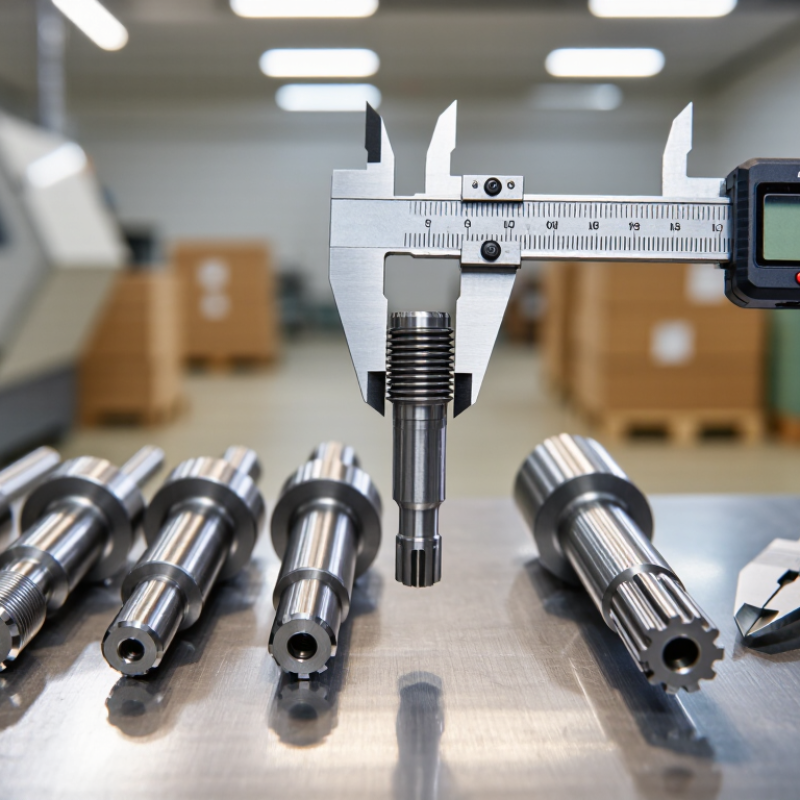
Top Motor Threaded Shaft Suppliers for Global Buyers

Motor Threaded Shafts: Types, Functions, and Motor Applications

Threaded motor shafts transmit rotation while providing a secure connection to driven components. Their threads may be external, internal, or limited to one end. Common designs include straight shafts, stepped shafts, and screw-type shafts. Each serves different load and motion requirements. Small details matter.

In a compact pump, a threaded end may secure an impeller or coupling with a nut. In a linear actuator, a screw-type shaft converts rotation into controlled travel. Stepped shafts support bearings and gears at different diameters, helping maintain alignment. Thread pitch and direction affect fit, vibration, and resistance to loosening. A mismatch may seem minor, then cause uneven wear.

Material and finish should suit the operating environment. Carbon or alloy steel offers strength, while stainless steel can be useful where moisture is present. Heat treatment, thread accuracy, and shaft runout influence service life. Buyers should confirm dimensions, torque, speed, and lubrication needs before choosing a supplier. Request inspection data for critical features. It is easy to focus only on overall length, but that can be a costly oversight. Specifications may also need adjustment after prototype testing. A little caution helps.

Thread Forms and Fits: ISO 965 Classes 6g and 6H

Top Motor Threaded Shaft Suppliers for Global Buyers

Thread Forms and Fits: ISO 965 Classes 6g and 6H

For motor threaded shafts, a clear thread callout helps buyers compare suppliers and avoid assembly surprises. ISO 965 sets tolerance rules for metric screw threads. It does not specify shaft material, strength, or runout. Those details belong on the drawing.

Class 6g is a common tolerance class for external threads. The lowercase “g” identifies an allowance below the basic size, leaving room for clearance. Class 6H is widely used for internal threads; uppercase “H” has zero fundamental deviation. A 6g shaft thread paired with a 6H tapped hole is a familiar combination. Still, actual fit depends on diameter, pitch, engagement length, and any coating. Check the complete callout, such as M8 × 1.25-6g, rather than relying on “standard thread.”

Measure carefully. A supplier can use calibrated ring gauges for external threads and plug gauges for internal threads, alongside pitch-diameter checks when the application requires them. Burrs at the thread start can catch during assembly. So can a mismatch between the thread axis and the bearing journal. ISO 965 classes alone do not address that alignment. Specify relevant runout limits and inspection records on the drawing. One detail is easy to miss: a fit that turns smoothly by hand may still need validation under the motor’s actual load and vibration.

Top Motor Threaded Shaft Suppliers for Global Buyers - Thread Forms and Fits: ISO 965 Classes 6g and 6H
Specification Area Reference Data Relevance to Motor Threaded Shafts What Buyers Should Confirm
Thread form ISO metric screw thread form, 60° flank angle, defined by ISO 68-1. Common form for metric fastening threads on shafts, studs, and mating components. Confirm that the drawing specifies an ISO metric thread and identifies the required diameter and pitch.
External thread tolerance 6g is a commonly used tolerance class for external metric threads. The lowercase letter “g” identifies the tolerance position. May be specified for a motor shaft end intended to mate with a compatible internal thread. Request the applicable ISO 965 tolerance limits and confirm whether coating or plating is included in the finished dimensions.
Internal thread tolerance 6H is a commonly used tolerance class for internal metric threads. The uppercase letter “H” identifies the tolerance position. Can be specified for a mating nut or tapped component; 6g/6H is a commonly used external/internal class combination. Confirm the internal thread class separately from the shaft’s external thread class.
Example: M6 × 1 Nominal diameter: 6 mm; pitch: 1.00 mm. ISO metric coarse-pitch example suitable for specifying a small threaded shaft end where the design calls for this size. State the full designation, such as M6 × 1 - 6g for an external thread, when that class is required.
Example: M8 × 1.25 Nominal diameter: 8 mm; pitch: 1.25 mm. ISO metric coarse-pitch example frequently encountered in general machine fastening applications. Specify thread length, runout or relief requirements, and the thread class on the drawing.
Example: M10 × 1.5 Nominal diameter: 10 mm; pitch: 1.50 mm. ISO metric coarse-pitch example for designs requiring a larger nominal thread than M8. Confirm the pitch rather than relying on nominal diameter alone; fine-pitch versions have different designations.
Example: M12 × 1.75 Nominal diameter: 12 mm; pitch: 1.75 mm. ISO metric coarse-pitch example that may be used when specified by the motor or assembly design. Verify the mating component uses the same nominal diameter and pitch before production.
Thread inspection ISO 1502 covers gauges and gauging for ISO general-purpose metric screw threads. Thread gauges can help verify thread conformity during manufacturing and incoming inspection. Agree on the inspection method, gauge status, sampling plan, and inspection records before order release.
Supplier quotation details Useful drawing inputs include thread designation, tolerance class, pitch, hand, thread length, material, finish, and quantity. Complete specifications help suppliers assess machining, rolling, finishing, and inspection requirements for a shaft. Request a drawing review and confirmation of the finished-part thread requirements before approving production.
Important fit note ISO 965 tolerance classes define thread tolerances; the actual limits depend on the specified thread size and pitch. Confirm the complete designation and applicable standard edition on the engineering drawing. Do not treat a class combination as a substitute for checking the required assembly fit.

Materials and Dimensions: ISO 286 Limits and Fits for Shaft Design

Top Motor Threaded Shaft Suppliers for Global Buyers

Materials and Dimensions: ISO 286 Limits and Fits for Shaft Design

A motor shaft’s material sets its strength, but its fit controls how parts meet. ISO 286-1 and ISO 286-2 define tolerance grades and deviations for cylindrical components. At a 20 mm nominal size, the ISO 286-2 table gives an IT7 tolerance of 21 μm and an IT6 tolerance of 13 μm. These grades describe tolerance width, not the complete fit. The selected shaft deviation and mating bore still determine clearance or interference. Small errors matter. The U.S. Department of Energy’s 2014 motor-systems sourcebook reports that motor-driven systems use about 68% of U.S. industrial electricity. That context makes reliable shaft alignment worth careful attention, though a tighter fit alone does not guarantee better efficiency.

For threaded motor shafts, check the thread, bearing seat, and coupling dimensions separately. A shaft can meet its nominal diameter yet bind at a bearing seat after machining or coating. Steel suits many load-bearing applications; stainless steel may help where corrosion resistance matters. Confirm material grade, heat treatment, surface finish, and inspection method with the supplier. I have seen drawings specify limits clearly but leave finish assumptions vague. That gap deserves a second look.

Tips: State the nominal size, ISO tolerance grade, datum, and measurement temperature on the drawing. Ask for inspection results on critical diameters. Keep the fit practical, not merely tight.

Supplier Quality Checks: ISO 9001:2015, Traceability, and Inspection

For global buyers sourcing motor threaded shafts, an ISO 9001:2015 certificate is a useful starting point, not proof that every shaft meets your drawing. Check that the certificate is current and covers the manufacturing site and processes involved. Ask how the supplier controls material changes, thread cutting, and final inspection. Clear answers matter.

Request traceability from the finished part back to its production lot and material records. A batch label should match the inspection report, material certificate, and order documentation. For a sample shaft, compare thread size with a calibrated gauge and check overall length, shoulder dimensions, and runout. Ask whether inspection results are recorded against defined tolerances. Paperwork can look tidy while a small process drift goes unnoticed; review actual records, not just procedures. Inspection methods may also need clarification before production begins.

Tips: Agree on critical dimensions and acceptance criteria in writing. Ask for first-article results before approving a large order. Confirm measuring equipment calibration dates, too. A missed detail is easy to regret.

Top Motor Threaded Shaft Suppliers for Global Buyers

Supplier Quality Checks: ISO 9001:2015, Traceability, and Inspection

The bars count the ISO 9001:2015 clause references shown for each quality-check area—not supplier performance scores. Traceability applies when required, and inspection and release criteria should be defined for the product and order.

Global Sourcing Factors: Capacity, Lead Times, MOQ, and Incoterms® 2020

For motor threaded shafts, supplier capacity should be checked against the actual drawing, not a broad monthly output claim. Ask how many machines can hold the required diameter, thread pitch, and runout tolerance at once. A sample inspection report and a recent production schedule reveal more than a polished catalog. Details matter. A supplier may have ample capacity but still rely on one plating or heat-treatment partner.

Lead times need similar scrutiny. Separate raw-material procurement, machining, finishing, inspection, and transit in the quoted schedule. For repeat orders, compare the stated lead time with recent shipment records, while allowing for seasonal congestion. Buffers help. Yet excessive buffer stock can hide planning problems and tie up cash. Request a clear update point if a critical process slips.

Minimum order quantity should be tied to setup cost, bar-stock yield, and inspection effort. Ask whether a pilot lot can use the same process controls as full production. A low MOQ is useful, but not if it changes the material source or weakens traceability. This deserves a second look.

Under Incoterms® 2020, name the exact rule and named place in every quotation. Clarify who arranges freight, export clearance, insurance, and import formalities; responsibility depends on the selected rule. Do not assume “delivered” means duties are included. Read the named place. Put packaging, shaft protection, and damage claims in writing before placing the order.

Go to Top