What Are the Top Voltage Instrument Types in 2026?
Voltage measurement is becoming less forgiving. Solar inverters, battery systems, fast chargers, and data-center power supplies can produce waveforms that a basic meter may not explain. The International Energy Agency’s 2023 report, Electricity Grids and Secure Energy Transitions, estimates that annual grid investment must exceed $600 billion by 2030. That expansion increases the need for dependable testing across equipment, installations, and maintenance work. It does not, by itself, prove which instrument will sell best in 2026. A neat ranking can mislead.
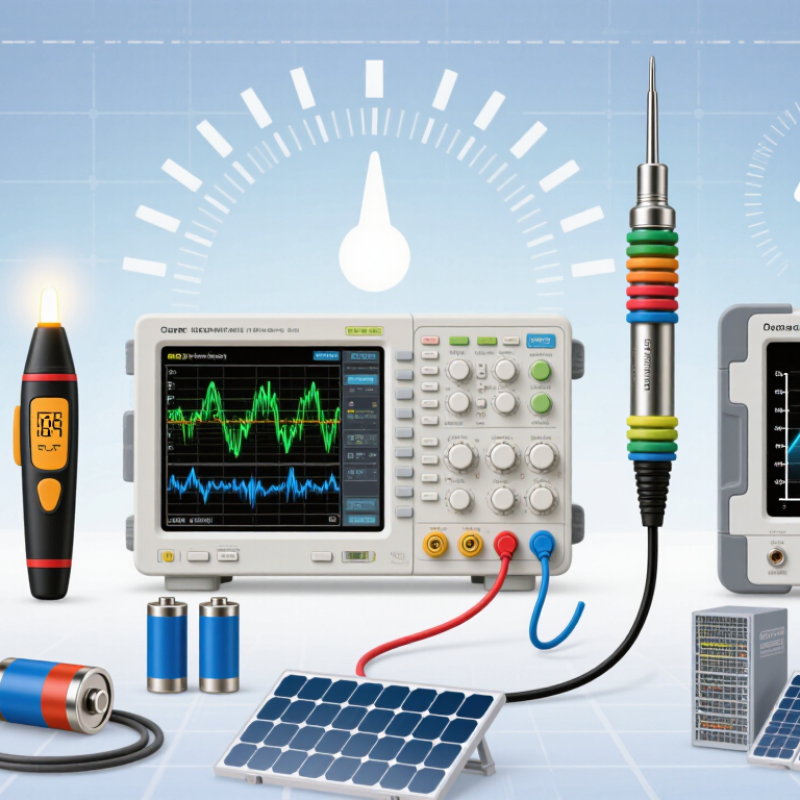
This guide compares the main Voltage Instrument types by what they measure and where they fit: digital multimeters, non-contact voltage testers, oscilloscopes, high-voltage probes, and power quality analyzers. A multimeter suits routine checks. An oscilloscope reveals changing waveforms. A power quality analyzer records disturbances over time. Not every tool fits. The probe matters. Safety and measurement category ratings matter, too; IEC 61010-1 provides widely used safety requirements for electrical measurement equipment. Buyers should check the instrument’s rated voltage, input limits, accuracy specification, and calibration status against the task. Accuracy is only one part. We will also note practical trade-offs, such as portability versus logging detail. Some tool categories overlap, and that deserves a closer look. The best choice depends on the signal, the working environment, and the evidence a technician needs—not on a headline ranking alone.
Core Principles of Voltage Measurement
Voltage is the electrical potential difference between two points, measured in volts. Every instrument samples that difference through its input circuit. Its impedance can draw current and change the circuit being measured. Small detail, big effect.
A digital multimeter suits steady readings, while an oscilloscope reveals fast changes, ripple, and brief spikes. High-voltage dividers scale down large signals for measurement; differential probes compare two points without grounding either one. True-RMS capability matters when waveforms are distorted, since a simple average-based meter may misstate heating-related voltage. Probe bandwidth, input capacitance, and transient rating also affect results. The right instrument depends on the signal, not just its peak value.
Reliable readings need a traceable reference and a stated uncertainty. The BIPM’s 9th edition of the SI Brochure fixes the elementary charge at 1.602176634 × 10⁻¹⁹ coulomb, supporting the SI foundation for electrical measurements. NIST Technical Note 1297 describes expanded uncertainty as U = kuc; a coverage factor of 2 often approximates 95% coverage under suitable assumptions. That is not a guarantee for every setup. A stable display can still hide poor probe contact, loading, or an unsuitable measurement range—details worth checking twice.
Multimeters and Voltage Testers for Everyday Electrical Checks
For everyday electrical checks in 2026, digital multimeters and voltage testers remain practical choices. A multimeter measures voltage and can also check resistance or continuity. A two-pole voltage tester gives a quick indication of voltage between two points. Non-contact testers are convenient for screening, but they cannot confirm that a circuit is safe to touch. Small display. Big consequences.
Electrical Safety Foundation International’s workplace electrical-safety materials cite about 30,000 nonfatal electrical shock accidents annually in the United States. That figure is a safety warning, not proof that any instrument prevents injury. Choose equipment with a suitable measurement range and overvoltage category for the circuit. Inspect probes for cracked insulation, and follow the instrument’s instructions. If a reading is unexpected, stop and ask a qualified electrician rather than guessing.
Tips: Before and after checking a circuit, verify the tester on a known live source. Use properly rated probes, keep fingers behind their guards, and never rely on a non-contact tester alone to confirm de-energization. A rushed check can miss a hazard.
Oscilloscopes and Data Loggers for Changing Voltage Signals
Changing voltage signals need instruments that capture both fast edges and slow drift. Oscilloscopes reveal ripple, switching transients, and brief dips that a handheld meter may miss. Choose bandwidth and sample rate for the signal, not just the instrument’s headline specifications. A suitable probe matters too: poor grounding can add ringing that was never present in the circuit. Small details count.
Data loggers suit longer measurements across multiple channels, such as voltage changes during a temperature cycle or overnight equipment run. Check input isolation, timestamp accuracy, resolution, and storage capacity before deployment. The International Energy Agency’s Electricity 2024 report projected global electricity demand growth of about 4% in 2024, underscoring the need to monitor changing electrical loads. The North American Electric Reliability Corporation’s 2024 Long-Term Reliability Assessment projected peak demand growth of 132 GW over the following decade. Those forecasts do not specify an instrument, but they make sustained, well-timed measurements increasingly useful. One limitation remains: logging intervals can hide short events. Pair a logger with an oscilloscope when both long-term trends and fast transients matter. A tidy trace can still mislead. Check probe setup, calibration status, and sampling settings before treating an anomaly as real.
Top Voltage Instrument Types in 2026: Oscilloscopes and Data Loggers
A simulated voltage transient illustrates the difference in time resolution: an oscilloscope trace sampled every 1 ms captures a brief event, while a data logger sampled every 10 ms may miss it. Oscilloscopes suit fast-changing signals; data loggers suit longer-term trends.
How to Choose a Voltage Instrument for the Task
How to Choose a Voltage Instrument for the Task
Start with the signal, not the instrument’s maximum voltage rating. A digital multimeter suits steady readings at outlets, terminals, and battery contacts. For fast-changing waveforms, an oscilloscope shows timing and shape that a meter may miss. A voltage tester offers quick presence checks, while a power-quality analyzer records dips, swells, and harmonics. That matters. Check the expected voltage, frequency, waveform, and transient environment before connecting any leads. For distribution panels, confirm the instrument’s measurement category and working-voltage rating match the location. IEC 61010-2-030 sets safety requirements for testing and measuring circuits; category markings help describe the intended electrical environment.
Then weigh accuracy, bandwidth, input impedance, and usability against the task. A high-impedance meter can reveal voltage on an unloaded wire that disappears under load; verify consequential readings with an appropriate method. NIST Technical Note 1297 explains that expanded uncertainty is calculated using a coverage factor; k = 2 often corresponds to roughly 95% coverage under stated assumptions. So a displayed 230 V is not automatically exact. In maintenance work, note the instrument’s calibration status, probe condition, and measurement range. A tidy specification sheet can still mislead. Choose a meter for routine checks, a scope for waveform questions, or a recorder when changes over time matter. A small mistake: selecting by resolution alone. More digits do not guarantee a more trustworthy result.