What Types of Powder Mixing Equipment Are Available?
Choosing Powder Mixing Equipment begins with a practical question: what must the blend do, and how consistent must it be? A ribbon blender moves dry ingredients with helical paddles, while a tumble mixer gently rotates a closed vessel. High-shear mixers use faster-moving components to disperse or granulate materials. These machines can look similar in a catalog. Inside, their mixing action differs.
Industry analyses, including Grand View Research’s coverage of industrial mixers and MarketsandMarkets’ market research on mixing equipment, discuss demand across manufacturing sectors. Such reports offer useful market context, but they do not replace application testing. Bulk density, particle size, moisture, batch volume, and cleaning requirements all influence equipment selection. A powder that flows freely may blend quickly in a tumble mixer; a cohesive formulation may need a different approach. Small details matter. A dusty discharge point or hard-to-clean corner can complicate an otherwise sound design.
Powder-mixing researcher R. Hogg has published extensively on particulate mixing. A careful summary of his research—not a verbatim quotation—is: “Mixing performance depends on both the material and the process conditions.” That distinction is easy to overlook. It is also why equipment comparisons should consider blend uniformity, scale-up, containment, and discharge behavior, not just advertised capacity. The sections ahead introduce common mixer types, explain their operating principles, and outline where each may fit. No single machine suits every powder. Real materials can be stubborn. Testing with representative ingredients remains a sensible step before specifying a system.
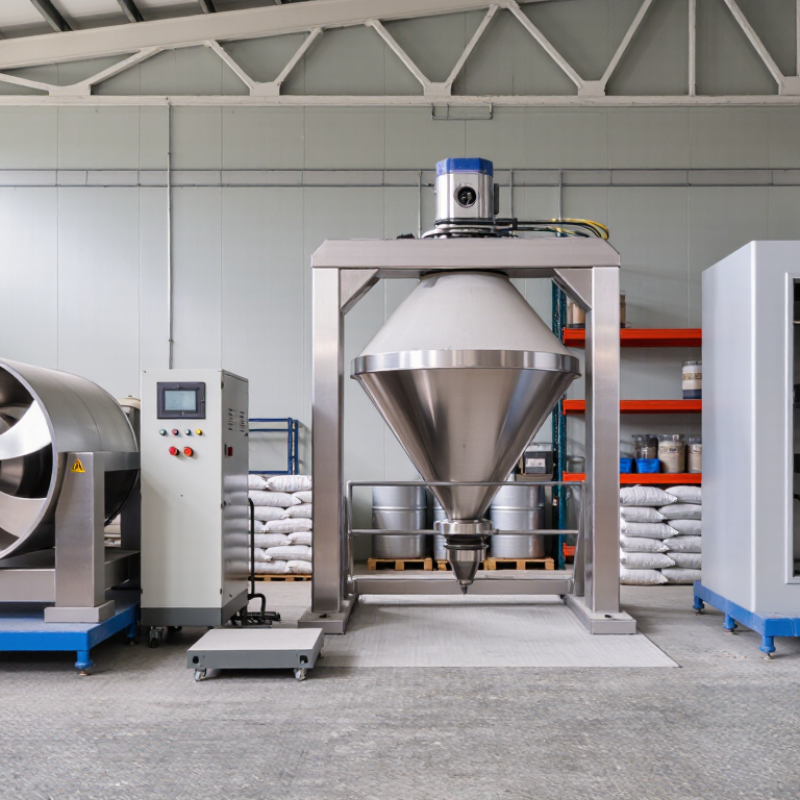
How Powder Mixers Are Classified by Motion and Batch or Continuous Operation
Powder mixers are commonly classified by motion and by operating mode. Tumble mixers rotate a drum or cone, letting particles cascade over one another. They suit gentle blending when ingredients tolerate limited impact. Convective mixers use paddles, ribbons, or screws to move material through the vessel. High-shear systems add faster, more forceful action for cohesive powders. The right choice depends on particle size, moisture, density, and fragility—not just the mixer’s name.
Operating mode is the second distinction. Batch equipment processes a measured load, then empties before the next run. It offers clear changeovers and practical sampling, but production pauses between batches. Continuous mixers receive and discharge powder while running. They can support steady production, provided feeders keep the ingredient ratio stable. Small flow variations matter. A short trial with representative powder can expose segregation or buildup that a brochure may not reveal.
MarketsandMarkets estimated the industrial mixers market at USD 1.9 billion in 2021 and projected USD 2.6 billion by 2026, a 6.5% compound annual growth rate. This broad market estimate signals continued equipment investment, but it does not identify one best mixer for every powder. Motion and operating mode should be assessed together: a gentle batch tumbler and a continuous screw mixer solve different process problems. There is no perfect classification shortcut.
What Types of Powder Mixing Equipment Are Available?
Powder mixers are classified by their mixing motion and by whether they operate in batches or continuously.
Each colored segment represents a commonly available operating mode, not market share or capacity. Tumble blenders are typically batch machines; ribbon, paddle, and ploughshare mixers are available in batch and continuous designs. Continuous screw mixers are designed for continuous operation.
How Tumble Blenders Mix Powders at About 50–60% Vessel Fill
Tumble blenders mix powder by rotating a vessel, allowing the contents to lift and fall through open space. At about 50–60% vessel fill, there is often enough room for this cascading motion. The powder rolls in layers rather than being forced by a high-speed blade. That motion matters. A visible wave of material should travel through the vessel as it turns.
The fill range is a useful starting point, not a fixed rule. Vessel shape, rotation speed, particle size, and flow behavior all affect mixing. A free-flowing granule may cascade smoothly, while a cohesive fine powder can move in clumps. That difference may be easy to miss from outside the vessel. During trials, compare samples taken from several locations and check whether the blend stays consistent over time. Watch for powder sticking to the walls or collecting in corners. More material is not automatically better; a nearly full vessel can restrict movement. One point deserves a second look: the same fill percentage can behave differently with another powder, so confirm the setting with actual material and process conditions.
How Ribbon and Paddle Mixers Use Convective Mixing at 30–70% Fill
Ribbon and paddle mixers blend powders mainly through convective motion: blades lift and move groups of particles through the vessel. At 30–70% fill, the material needs room to circulate; overfilling can create a sluggish top layer, while very low loads may reduce blade contact. Industrial blender-selection guidance commonly uses this fill band as a starting point, not a guaranteed optimum. Harnby, Edwards, and Nienow’s Mixing in the Process Industries explains why mixing depends on equipment geometry and material behavior. In practice, a free-flowing granule and a fine, cohesive powder may behave very differently at the same fill level. The numbers are only a start.
Tips: Check the batch during commissioning. Look for powder moving across the full vessel, not just rolling near the shaft. Record fill, mixing time, and sample results; a small sampling error can mislead. If the blend looks uniform, test it.
Ribbon mixers suit many routine dry blends, while paddle mixers can handle gentle movement and varied particle sizes. Neither guarantees uniformity by itself. Validate with samples from several locations and repeat the test at the smallest and largest planned batch sizes. Industry references such as Harnby et al. offer useful mixing principles, but actual performance still depends on the powder, blade design, and operating conditions.
How High-Shear and Fluidized-Bed Mixers Add Intensive or Gas-Assisted Mixing
High-shear mixers use fast-moving blades to disperse ingredients, break soft agglomerates, and create strong local turbulence. They suit cohesive powders or recipes needing rapid, repeatable blending. Watch the heat. Friction can warm the batch, while excessive shear may damage fragile particles. Check blend uniformity and temperature at several points, not only near the vessel wall.
Fluidized-bed mixers lift powder with an upward air stream, allowing particles to circulate and mix with less direct mechanical contact. Airflow, particle size, and moisture all affect performance; poor control can cause channeling or segregation. A useful starting point is the powder’s measured bulk density and flow behavior. ASTM D7481 provides methods for measuring loose and tapped bulk density, but those results alone do not predict fluidization. MarketsandMarkets projected the industrial mixers market to grow from US$1.9 billion in 2022 to US$2.6 billion by 2027, a 6.1% compound annual growth rate. That market estimate signals investment, not proof that one mixer suits every powder. A small trial batch can reveal what the specification sheet misses.
How Blend Uniformity Is Assessed with a Common CV Target of ≤5%
Powder mixing equipment includes tumble blenders, ribbon mixers, paddle mixers, and high-shear units. Each moves material differently, so equipment choice can affect how quickly a blend becomes uniform. But a polished-looking powder is not proof of consistency. A sample taken near the vessel wall may differ from one collected at the center.
Blend uniformity is often assessed using the coefficient of variation, or CV. It is calculated as the standard deviation divided by the mean, then multiplied by 100. A CV of 5% or less is a common target, not a universal guarantee. For example, samples from several locations can be tested for a selected ingredient, then compared across the batch. Small differences matter.
Reliable results depend on representative sampling and a suitable analytical method. A few convenient scoops may miss pockets of concentrated material, especially in a large vessel. Sampling tools, sample size, and test precision all influence the result. Keep those details consistent. If repeated runs show a low CV, that supports uniformity under the tested conditions, but does not automatically predict every batch. I would also examine where samples came from and whether the method can detect meaningful variation. That part is easy to overlook.